
Hydrogen carbon cleaning: does it actually work?
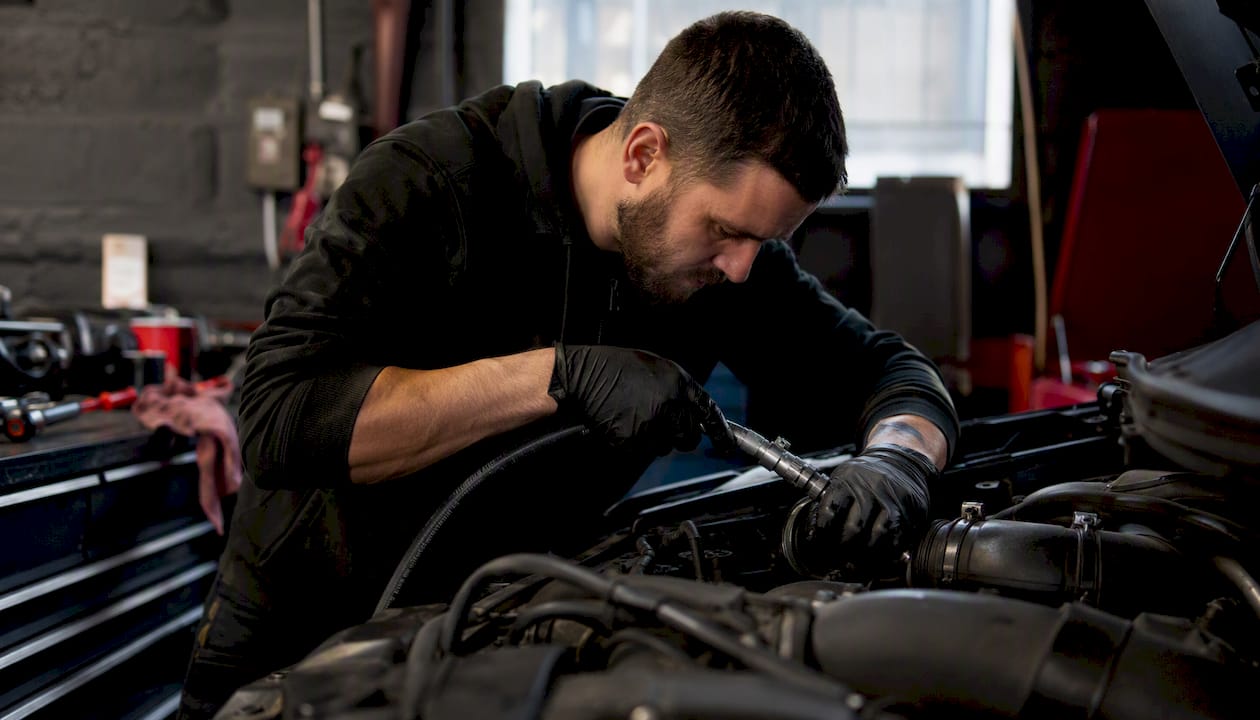
Hydrogen carbon cleaning works well as preventive maintenance for petrol and diesel engines with mild to moderate carbon build-up. It is not a fix for mechanically failed components, seized valves, or a DPF so blocked it has already triggered limp mode.
Typical session time: 30 minutes on the machine.
Approximate UK price range: £80–£200, depending on engine size and whether diagnostics are bundled (prices vary by provider)
Results vary by vehicle age, mileage, and the severity of deposits. A post-treatment test drive is not optional — it is the step that clears loosened carbon from the system before it can re-settle in the DPF or catalyst.
Key takeaways
Hydrogen carbon cleaning is effective preventive maintenance for mechanically sound engines with mild to moderate carbon build-up, but it will not repair failed components or clear a fully blocked DPF.
Point | Details |
Best use case | Preventive maintenance on sound engines; most effective before symptoms become severe. |
Realistic outcomes | Improved throttle response, steadier idle, lower DPF back-pressure; fuel savings are smaller and variable. |
Vendor-claimed figures | Fuel reduction of 4–15% and maintenance-cost reductions up to 80% are vendor claims; treat as indicative. |
Test drive is mandatory | Loosened carbon must be expelled via a high-rev drive; skipping it risks re-deposition in the DPF. |
Performance Tuning NI | Offers onsite and mobile carbon cleaning in Northern Ireland, with diagnostics, written reports, and remap bundling available. |
Table of Contents
How does hydrogen carbon cleaning actually work?
Oxyhydrogen gas is produced by passing an electrical current through distilled water, then fed directly into the engine’s intake, where it mixes with the air-fuel charge and burns inside the combustion chamber. The water vapour produced in that reaction helps detach and combust carbon deposits that have built up on intake valves, piston crowns, and combustion chamber walls.
The process, step by step:
Electrolysis: Distilled water in the machine’s cell is split into hydrogen and oxygen (HHO gas) by a low-voltage current.
Intake injection: The gas is routed via a hose into the air intake upstream of the throttle body, so it is drawn in naturally as the engine runs.
Combustion reaction: Inside the chamber, HHO burns at a higher temperature than petrol or diesel alone. The chemical reactions between carbon, hydrogen and oxygen help oxidise and break down carbon deposits.
Test drive: Once the machine is disconnected, loosened particles must be expelled through the exhaust. A motorway-style drive at higher revs — typically 30–90 minutes of running — is recommended to push residues out rather than letting them settle in the DPF or catalytic converter.
Machine example: The TEXA H2 BLASTER is a professional-grade system that generates oxyhydrogen by electrolysis, injects it into the intake, and uses built-in safety controls including a hydrogen leak sensor, flame arrestor, and cell temperature sensor. It links to an OBD diagnostic app and generates a service report, with a recommended 5–6 km high-rev drive to complete the procedure.
Visualise it as a loop: water in → electricity splits it → gas enters intake → burns with fuel → water vapour and heat loosen carbon → exhaust drive clears the debris.
What benefits do owners and providers report?
The most consistent short-term gains are improved throttle response, a steadier idle, reduced exhaust smoke, and lower DPF back-pressure. Fuel-economy improvements tend to be smaller and take longer to show up in real-world driving.
Reported benefits include:
Improved throttle response: Carbon on intake valves restricts airflow; removing it lets the engine breathe more freely.
Steadier idle: Deposits on injector tips and combustion walls disrupt fuel atomisation; cleaning helps restore a smooth idle.
Reduced exhaust smoke: Particularly on diesels, where soot accumulation in the combustion chamber contributes to visible smoke at idle or under load.
Lower DPF back-pressure: Loosening soot upstream reduces the load on the filter, which can extend regeneration intervals.
Turbo response: Provider testing reports consistent short-term improvements in turbo speed and boost pressure after treatment, particularly on turbocharged diesel engines.
Small fuel-economy gains: Real-world results vary, but a cleaner combustion environment tends to improve efficiency over time.
Outcome | Vendor-claimed range | Notes |
Fuel consumption reduction | 4% (vendor-claimed) | H2E Decarbonisation figures; varies by vehicle and driving style |
Component maintenance-cost reduction | vendor claims indicate substantial potential cost savings | Vendor claim for specific components; treat as indicative |
Turbo boost improvement | Measurable short-term gain | Consistent in provider testing; magnitude varies |
These are vendor-claimed figures. Independent, peer-reviewed data on fuel savings is limited, and gains at the higher end of those ranges are unlikely for a well-maintained engine. Treat them as a ceiling, not a guarantee.
What does hydrogen cleaning actually remove, and what are its limits?
The technique reliably loosens and helps combust carbon deposits in areas the gas can reach: intake valves, combustion chamber walls, piston crowns, and the upstream side of the DPF. It does not repair mechanical damage, clear a fully blocked DPF, fix worn injectors, or address faults caused by oil consumption or coolant ingress.
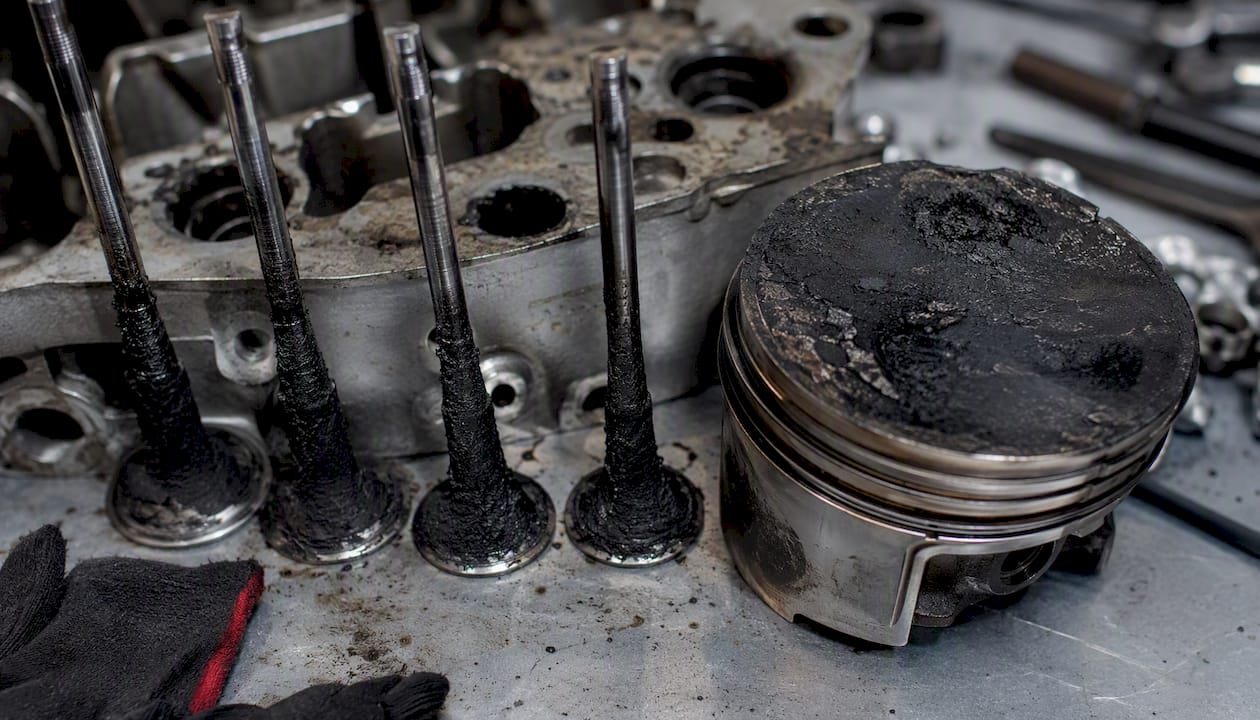
A realistic before/after picture from provider testing: turbo speed and boost pressure improve measurably, and exhaust opacity drops after treatment on vehicles with moderate carbon build-up. DPF differential pressure readings also tend to fall. These are short-term, measurable parameters. Long-term fuel-economy gains are smaller and depend heavily on subsequent driving and maintenance habits.
Limitations to be clear about:
Severe mechanical faults: A failed turbo, cracked injector, or worn piston rings will not be fixed by a cleaning cycle.
Fully blocked DPF: If the filter is beyond passive or active regeneration, hydrogen cleaning alone is unlikely to restore it.
Heavy ash deposits: Ash (from engine oil additives) does not combust the way soot does. HHO treatment addresses soot, not ash.
Seized EGR valves: A mechanically stuck valve needs physical intervention, not a gas treatment.
Persistent fault codes: Codes pointing to sensor failure, injector wear, or compression loss require diagnostics, not cleaning.
The quality of independent evidence is honest but limited. Most data comes from vendor testing and provider reports rather than controlled trials. That does not make the service ineffective — it means the realistic expectation is a cleaner, better-breathing engine, not a transformation.
What happens during a typical appointment?
A full appointment runs roughly 60–120 minutes from arrival to leaving the forecourt, including pre-diagnostics, the machine treatment, post-diagnostics, and the test drive. The technician takes baseline OBD readings first, before the machine is connected.
A standard session, in order:
Pre-diagnostic scan: OBD readings captured — DPF back-pressure, fuel trims, idle quality, exhaust opacity where measurable.
Machine connection: The HHO hose is attached to the air intake. The machine is set to the correct flow rate for the engine size.
Treatment run: The engine runs at controlled RPM while oxyhydrogen is drawn through the intake. Session duration is typically 30–120 minutes depending on the machine model and engine.
Post-diagnostic scan: The same OBD parameters are re-read and compared to the baseline.
Test drive: A drive at higher revs — ideally a short motorway or dual-carriageway run — expels loosened carbon through the exhaust system.
Written report: A reputable provider generates a service report showing before/after readings.
Petrol vs diesel differences:
Petrol direct-injection engines tend to accumulate carbon on intake valves faster because fuel does not wash the valves as it does in port-injection engines. They often benefit most from the treatment.
Diesel engines carry more soot load overall. The treatment addresses combustion-chamber deposits and can reduce DPF back-pressure, but a diesel with a severely loaded DPF may need a forced regeneration or professional DPF clean alongside the HHO session.
The test drive is not a formality. Loosened carbon particles that are not expelled can re-settle in the DPF, causing a pressure spike shortly after the service. A 5–6 km high-rev drive guided by the OBD app is the standard recommended by TEXA for their H2 BLASTER system.
Is hydrogen carbon cleaning safe?
The gas is flammable, and safe operation depends entirely on certified machines and trained operators. A reputable machine will have multiple automatic safeguards that prevent gas accumulation or ignition outside the combustion chamber.
Safety features to look for in a professional machine:
Hydrogen leak sensor: Detects gas escaping the cell or hose connections and triggers a cut-out.
Flame arrestor: Prevents any backfire from travelling back into the machine’s gas cell.
Cell temperature monitoring: Shuts the system down if the electrolysis cell overheats.
OBD-linked cut-out: Stops gas generation automatically if the engine stalls, preventing unburnt hydrogen from accumulating in the intake.
Risk-mitigation practices from a reputable provider:
Operator trained on the specific machine model, not just general automotive work.
Pre-diagnostic check to confirm the engine is running correctly before treatment begins.
Controlled gas-flow rate matched to engine displacement.
Supervised test drive, not a “drive it home and see how it feels” instruction.
In the UK, there is no specific legislation prohibiting hydrogen carbon cleaning, but the Health and Safety Executive’s general duty of care framework applies. Any workshop offering the service should be able to demonstrate that their machine is maintained, their operators are trained, and their procedure includes the safety checks above. If a provider cannot tell you what machine they use or what safety controls it has, that is a reason to walk away.
Pro Tip: Check whether the machine has a CE or equivalent certification mark. Reputable manufacturers publish their safety documentation — TEXA, for example, lists the H2 BLASTER’s safety features in its product documentation.
How much does hydrogen carbon cleaning cost in the UK?
Approximate UK pricing runs from £80 to £200 for a standalone session, with the variation driven by engine size, whether pre/post diagnostics are included, and the provider’s location and equipment. Mobile services may charge slightly more to cover travel.
When the service is good value:
Preventive use at 30,000–50,000 miles: Before significant symptoms appear, a clean engine responds better to the treatment.
Before an ECU remap: Cleaner airflow gives more predictable remap results. Providers commonly recommend bundling carbon cleaning with remapping for this reason.
Rising DPF back-pressure: If readings are climbing but the filter is not yet blocked, a cleaning session can buy time and reduce regeneration frequency.
After a long period of short-journey driving: Stop-start urban use accelerates carbon build-up, particularly on diesels.
When it is not good value:
The engine is already in limp mode or throwing fault codes for mechanical failure.
The DPF has been confirmed as blocked beyond regeneration.
The vehicle has known injector wear or significant oil consumption — cleaning will not address the root cause.
Scenario | Vendor-claimed outcome | Label |
Fuel consumption | 4% reduction | Vendor-claimed (H2E) |
DPF maintenance costs | Up to 80% reduction (specific components) | Vendor-claimed (H2E) |
Turbo boost | Measurable short-term improvement | Provider-reported (HHO CCS) |
At £80–£200, the payback calculation is straightforward if the service prevents one DPF replacement or extends a turbo’s service life. As a standalone fuel-saving measure on a well-maintained engine, the maths are tighter.
Who should book hydrogen carbon cleaning, and who should avoid it?
Good candidates are drivers with mild clogging symptoms on a mechanically sound engine, or those using the service preventively as part of a regular maintenance schedule.
Symptoms that suggest you could benefit:
Rough or lumpy idle that has developed gradually
Black or grey smoke at idle or under load (diesel)
Loss of low-end torque or sluggish throttle response
Rising DPF back-pressure readings without a confirmed blockage
Fuel consumption creeping up without a clear mechanical cause
Red flags that point to a different repair path:
Persistent fault codes for injector failure, MAF sensor, or turbo actuator
Engine already in limp mode
Failed emissions test with a known mechanical cause
DPF warning light combined with a confirmed blocked filter
Significant oil consumption or coolant loss
For preventive use, many providers and technicians suggest a session every 30,000–40,000 miles, or annually for high-mileage diesel vehicles used mainly on short runs. Maintaining ancillary components — such as keeping Haldex filter flow in good order on four-wheel-drive vehicles — alongside a cleaning schedule helps reduce overall drivetrain stress.
What should you ask a provider before booking?
Insist on pre and post diagnostics and a written report. Without those two things, you have no way to verify whether the treatment did anything.
Booking checklist:
Machine model: Ask specifically. A named, certified machine (such as the TEXA H2 BLASTER) is a better sign than a vague answer.
Safety features: Confirm the machine has a leak sensor, flame arrestor, and OBD-linked cut-out.
Pre/post diagnostic readouts: These should be provided as part of the service, not an optional extra.
Test-drive length and supervision: Ask how long and whether the technician accompanies you or monitors via OBD app.
Operator training: The person running the machine should be trained on that specific system.
Written report: A service report with before/after readings is standard on professional equipment.
Red flags to avoid:
No diagnostics offered, or diagnostics quoted as a separate upsell after the fact.
Vague claims about “guaranteed” results or percentage improvements without any baseline data.
Unwillingness to name the machine or show its safety documentation.
No mention of a post-service drive, or a dismissive “just drive home normally” instruction.
No written record of the service.
How Performancetuningni delivers engine carbon cleaning
Performancetuningni offers engine carbon cleaning as both an onsite and mobile service in Northern Ireland, covering petrol and diesel engines. The service is available as a standalone appointment or bundled with ECU remapping and DPF-related work.
Bundling cleaning with a remap makes practical sense. A cleaner intake and combustion chamber gives the remap more accurate baseline data to work from, and the performance gains from tuning are more consistent when airflow is not restricted by carbon build-up. Performancetuningni’s remapping service is designed to work alongside the cleaning procedure for exactly this reason.
What to expect from a Performancetuningni appointment:
Pre and post OBD diagnostics as standard
Named machine and documented safety procedure
Post-treatment test drive included
Written service record provided
Mobile option available for customers who cannot bring the vehicle to the workshop
To check whether your vehicle is a good candidate for a remap alongside the cleaning, use the free remap calculator on the Performancetuningni website — enter your registration and get an instant estimate of potential gains.
The part most providers do not tell you clearly enough
The marketing around hydrogen carbon cleaning leans heavily on the dramatic end of the outcome range. For a car that has been serviced regularly and driven sensibly, the gains will be real but modest.
That is not a reason to dismiss the service. It is a reason to frame it correctly. The strongest argument for hydrogen cleaning is not the fuel saving. It is the extension of component life. A turbo that runs with less carbon restriction lasts longer. A DPF that is not fighting upstream soot accumulation regenerates more efficiently. An EGR system that is not caked in deposits causes fewer faults. None of that shows up dramatically on a single before/after readout, but it compounds over years of ownership.
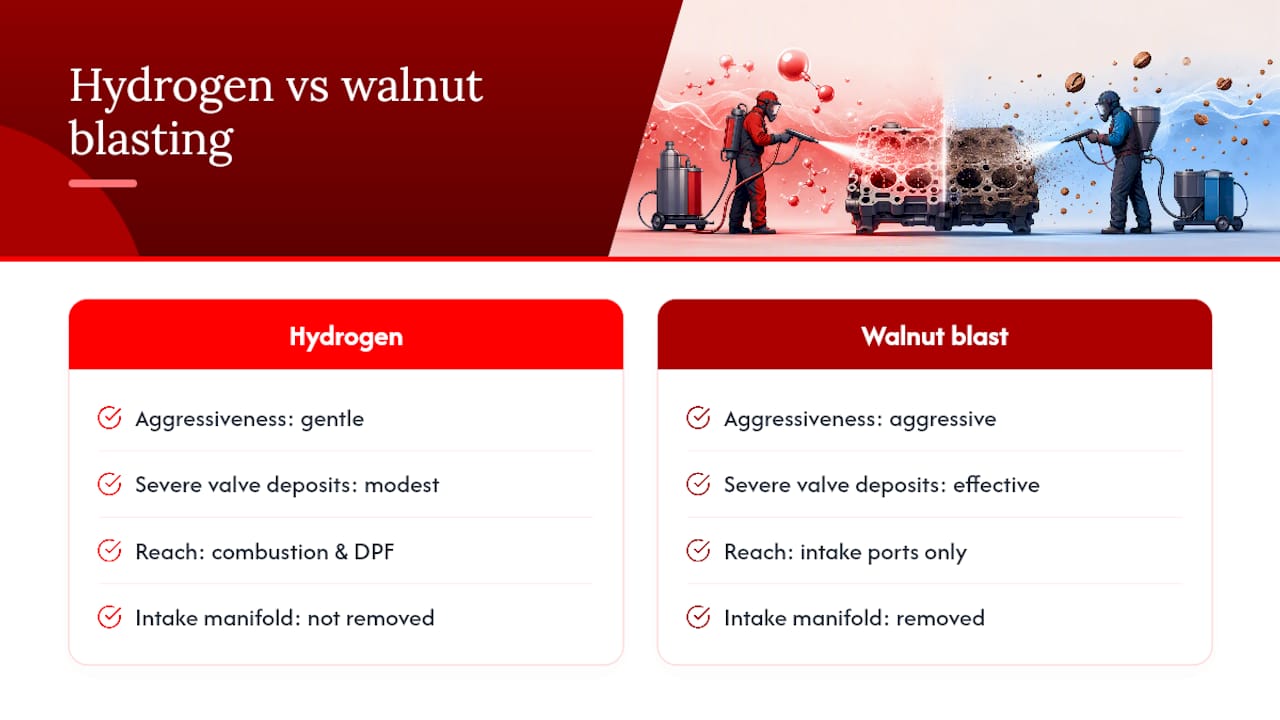
The comparison with walnut blasting is worth addressing directly. Walnut blasting uses crushed walnut shells blasted through the intake ports to physically abrade carbon from intake valves. It is more aggressive and more effective for severe valve deposits, particularly on petrol direct-injection engines. Hydrogen cleaning is gentler, reaches areas walnut blasting cannot (combustion chamber, DPF upstream), and does not require the intake manifold to be removed. For moderate build-up, hydrogen cleaning is the lower-risk, lower-cost option. For heavy valve deposits on a GDI engine, walnut blasting may be the better call. The two are not in competition — they address overlapping but distinct problems.
What I would tell any driver considering this service: book it preventively, not desperately. The results are most consistent when the engine is not already struggling. And insist on the diagnostics and the test drive. A provider who skips either is not delivering the service properly, regardless of what machine they are using.
Performancetuningni: carbon cleaning and remapping in Northern Ireland
If you have read this far and your engine has been running on short journeys, accumulating carbon quietly for the past few years, the practical next step is a diagnostic-led cleaning appointment rather than waiting for a warning light.
[
Performancetuningni brings the service to you — onsite or mobile across Northern Ireland — with pre and post OBD diagnostics, a named professional machine, a supervised test drive, and a written report as standard. For drivers who want to go further, bundling the carbon clean with an ECU remap gives the tuning work a cleaner baseline to work from, which means more consistent and measurable performance gains. The combination is particularly effective on turbocharged petrol and diesel engines where carbon restriction has been quietly blunting the engine’s response.
Check your vehicle’s remap potential now with the free remap calculator, or book a carbon cleaning appointment directly and get a before/after report that shows exactly what the treatment achieved.
Sources
Recommended